Here is the CMT Uptime check phrase Skip to main content

Addressing Systemic Racism: The Impact on African Americans with Alzheimer’s Disease and Related Dementia

This is the final session of a seven-month series in which the University of Wisconsin Center for Community Engagement and Health Partnerships explores how racism impacts African Americans with Alzheimer’s and related dementia. Gina Green-Harris, award-winning Director of the Wisconsin Alzheimer’s Institute presents the status of Alzheimer’s from the perspective of her institute, followed by […]

This is the final session of a seven-month series in which the University of Wisconsin Center for Community Engagement and Health Partnerships explores how racism impacts African Americans with Alzheimer’s and related dementia. Gina Green-Harris, award-winning Director of the Wisconsin Alzheimer’s Institute presents the status of Alzheimer’s from the perspective of her institute, followed by a robust panel discussion Nia Norris, Assistant Director of the Wisconsin Alzheimer’s Institute; Stephanie Houston, Senior Outreach Specialist at the Wisconsin Alzheimer’s Institute; and Bashir Easter, Ph.D., Assistant Director of the UW All of US Research Program in Milwaukee who’s done research on adolescents as caregivers to Alzheimer’s patients.

Registration Required.

Please feel free to email any questions for the panel to [email protected].
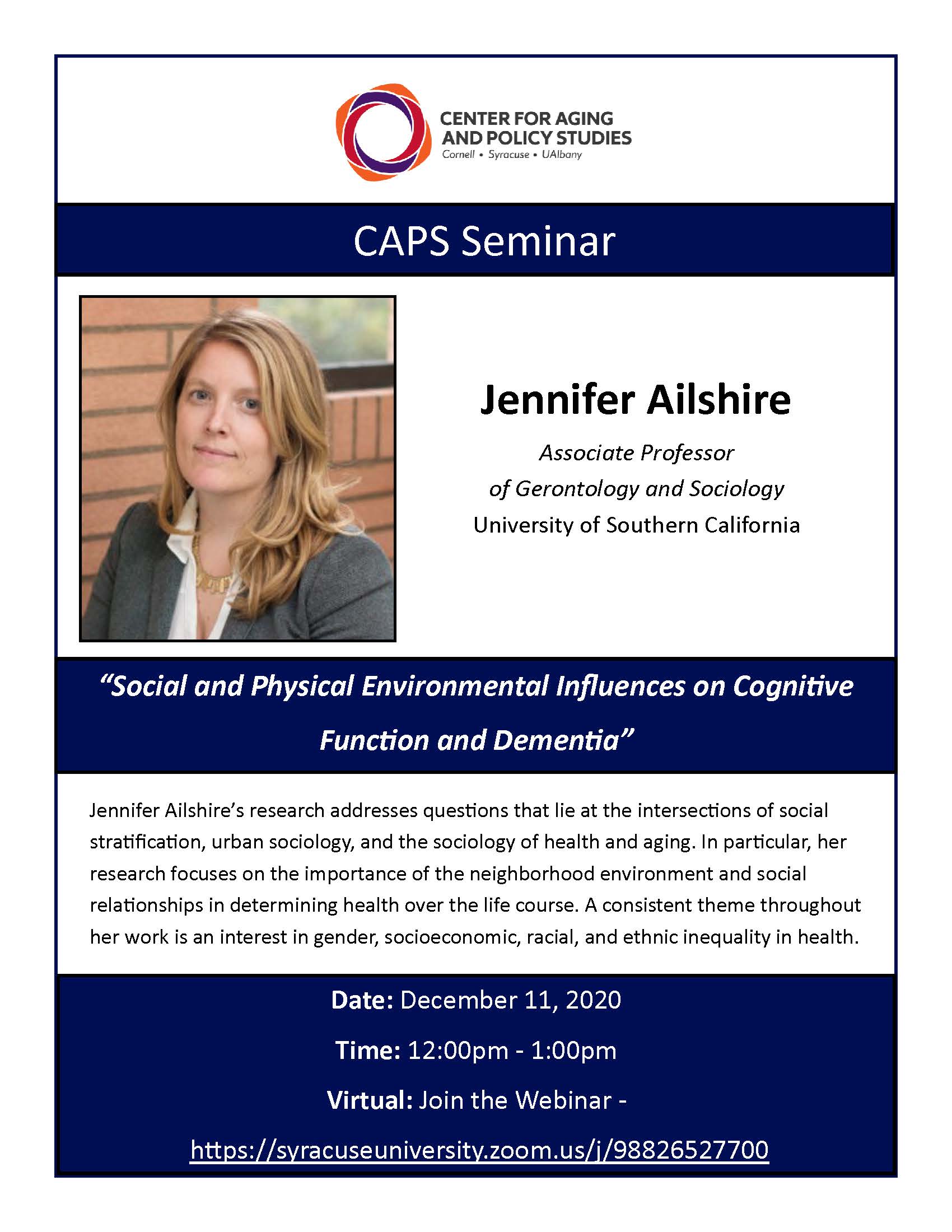
Jennifer Ailshire, Associate Professor of Gerontology and Sociology, University of Southern California, will speak on, “Social and Physical Environmental Influences on Cognitive Function and Dementia.”

Dec 11, 2020, 9:00 am – 10:00 am EST

Zoom Link

Event Flyer

Jennifer Ailshire’s research addresses questions that lie at the intersections of social stratification, urban sociology, and the sociology of health and aging. In particular, her research focuses on the importance of the neighborhood environment and social relationships in determining health over the life course. A consistent theme throughout her work is an interest in gender, socioeconomic, racial, and ethnic inequality in health.

Current projects include research on the links between air pollution and health in older adults, neighborhood determinants of racial and ethnic health disparities, and social factors associated with poor sleep.

The meeting will include sessions on Early Life, The Emerging Adult, Chronic and Acute Stress, and Mechanisms and Models. This workshop will be held as a webinar, and registration is free and open to the public.


Agenda (PDF)

2020 William R. Hazzard, MD Translational Research in Aging Symposium: COVID-19 and Older Adults

The Hazzard Symposium is an annual event at Wake Forest School of Medicine which features internationally-renowned speakers in gerontology and geriatric medicine with the purpose of translating discoveries in aging research to the care of older adults. The topic for this year’s Symposium is “COVID-19 and Older Adults.” Themes of the Symposium include: Geroscience Approaches; Population Impact; and Telehealth Applications During COVID-19.

The Keynote Speaker for the 2020 Hazzard Symposium is Joan Mannick, MD, Chief Medical Officer of resTORbio. Her Keynote address will be “Targeting Immunosenescence with mTOR Inhibitors.”

This symposium will be held from 10am-3pm ET. The Hazzard Symposium is sponsored by Arbor Acres Retirement Community and The Sticht Center for Healthy Aging and Alzheimer’s Prevention, with support from the American Federation for Aging Research.

Agenda (PDF)

AFA’s educational webinar will explore the question of racial disparities and their impact on increasing incidences of dementia-related illnesses, including Alzheimer’s disease, among Black, Indigenous and People of Color (BIPOC). Specifically, our panelists will discuss:
AFA’s educational webinar will explore the question of racial disparities and their impact on increasing incidences of dementia-related illnesses, including Alzheimer’s disease, among Black, Indigenous and People of Color (BIPOC).
Specifically, our panelists will discuss:
  • How racism and discrimination increase risk factors of cognitive decline and dementia in BIPOC communities;
  • Differences in dementia caregiving in BIPOC communities;
  • The impact of racism on public health initiatives and preventive health measures;
  • Gaps in research on such disparities in dementia; and
  • Outreach strategies to increase BIPOC participation in clinical studies.
Opening Remarks: Congresswoman Maxine Waters (D-CA) Co-Chair, Congressional Bipartisan Task Force on Alzheimer’s Disease.
Panelists:
Luisa Echevarria Member, AFA Board of Directors Director of Community Empowerment Univision Communications, Inc.
Jennifer J. Manly, PhD Associate Professor of Neuropsychology The Neurological Institute of New York Columbia University Medical Center
Roland J. Thorpe, Jr., PhD Professor, Health Behavior and Society John Hopkins University
The University of Wisconsin­–Madison will host the 11th Annual Midwest Health Economics Conference virtually on September 17-18, 2020. Local sponsors are the Center for Demography of Health and Aging, La Follette School of Public Affairs, School of Business, Department of Economics, and Department of Population Health Sciences. This annual invitational conference assembles junior and senior economists to present, debate, and discuss cutting-edge health economics research. Registration is required
The Gerontological Society of America 2020 Annual Scientific Meeting Online brings together researchers, educators, scientists, health care professionals, influential thought leaders, and industry experts to address today’s most pressing issues in the field of aging. Attendees will have easy access to all sessions, networking opportunities, and may enjoy each program at their convenience at GSA’s state-of-the-art online conference. Top 10 Topics
  • Alzheimer’s Disease and Related Dementias
  • Family Caregiving
  • Long-Term Care
  • Cognition
  • Minority & Diverse Populations
  • Education and Training
  • Social determinants of Health and Aging
  • Aging in Place
  • Mental Health
  • Family and Intergenerational Relations
The meeting includes:
  • 75 streaming symposia
  • Over 250 on-demand symposia
  • 450 on-demand paper presentations
  • 1500 posters
  • Live discussions with every presenter
  • Networking Opportunities
The 2020 theme, “Turning 75: Why Age Matters,” was selected as a celebration of GSA’s 75th Anniversary! We’re celebrating the collective accomplishments of members that have strengthened the field of aging and the mission of GSA. Presentations, programs, and activities will reflect the theme of the 75th year which is “honor the past and enrich the future.” https://www.geron.org/meetings-events/gsa-2020-annual-scientific-meeting

Human beings are social creatures, thriving on connections with others. These connections can help to reduce social isolation and loneliness and lower risk for a variety of physical and mental health conditions. This webinar will focus on how social isolation and loneliness affect older adults’ health and well-being, particularly amid the unique challenges of the COVID-19 pandemic. The webinar will also address social isolation and loneliness in the context of Alzheimer’s disease and related dementias, emphasize the impact of health disparities, and provide information on potential interventions and mitigating technologies.

Presentations and Speakers:

  1. Social Isolation and Loneliness Among Older Adults During COVID-19 Ashwin Kotwal, MD, MS, University of California San Francisco Carla Perissinotto, MD, MHS, University of California San Francisco
  2. Social Isolation & Loneliness: Interrelationships with Health & Well-Being in Older Adults Louise Hawkley, PhD, NORC at the University of Chicago
  3. Managing Symptoms of Dementia, Maintaining Function, and Accessing Services During Isolation Sheria G. Robinson-Lane, PhD, RN, University of Michigan School of Nursing
  4. Identifying and Serving People Living Alone with Dementia Don Smith, Area Agency on Aging at United Way of Tarrant County
  5. I-CONECT Project: Using Video Chat to Reduce Social Isolation and Improve Cognitive Health Hiroko Dodge, PhD, Oregon Health & Science University

Series Information

Register

_________________________________________________________________________

This webinar series will address important topics for public health and health care professionals, aging services organizations, the research community, and other stakeholders in aging. The series is a joint project of four of the federal agencies that support the health and wellness of older adults in the U.S.: the Administration for Community Living, the Centers for Disease Control and Prevention, the Health Resources and Services Administration, and the National Institute on Aging. In addition to general topics of interest for older adults and those who work with them, each webinar will include information specific to individuals with Alzheimer’s disease and other types of dementia, as well as their caregivers.

Please join the Friends of the National Institute on Aging (FoNIA) for a webinar on COVID: Opportunities and Obstacles in Aging Research and Caregiving which will explore the nexus between the COVID-19 virus and older adults.

Specifically, our three panelists will discuss:

– What does data around COVID tells us about existing racial, economic and geographical health disparities;
– How aging research can be more inclusive in light of COVID exposed disparities;
– Opportunities to study care needs of older adults and their caregivers during the COVID-19 pandemic; and
– How aging impacts the effectiveness of potential COVID treatments and vaccines.

The Resource Centers for Minority Aging Research (RCMAR) presents:

Stephen O. Sodeke, PhD, MA, Bioethicist and Professor of Allied Health Sciences and Bioethics at Tuskegee University College of Arts and Sciences, Center for Biomedical Research will talk at RCMAR’s February 14 2020 webinar. Dr. Sodeke has presented several times to the Deep South RCMAR on ethics issues and will be sharing his knowledge about bioethics in research this time with the entire national RCMAR audience. He has spoken on ethical issues in health research with communities of color to many national audiences and published widely on the topic. Don’t miss this important topic for all researchers in minority aging.

Pre Webinar Readings:
1. Race and Medicine: The Harm that Comes from Mistrust
2. Journal of Health Care for the Poor and Underserved