Here is the CMT Uptime check phrase Skip to main content

CAPS Annual Conference 2023 Visiting Scholar Keynote Address – Hui Zheng

Understanding American Health Trends: Deaths of Despair, Racial Disparities, and The Declining Health in Boomers to Millennials Sponsored by CAPS (Syracuse) Hui Zheng is a demographer, social epidemiologist, and quantitative social scientist. His research focuses on understanding the causes, heterogeneity, inequality, and trends of population health and aging. It encompasses two interconnected areas: social and […]

Understanding American Health Trends: Deaths of Despair, Racial Disparities, and The Declining Health in Boomers to Millennials

Sponsored by CAPS (Syracuse)

Hui ZhengHui Zheng is a demographer, social epidemiologist, and quantitative social scientist. His research focuses on understanding the causes, heterogeneity, inequality, and trends of population health and aging. It encompasses two interconnected areas: social and policy determinants of health, and population process of aging and mortality. He has investigated health consequences of various social structures, institutions, and policies; the trends of socioeconomic and demographic disparities in health; trend and heterogeneity in aging, mortality, and life span; the impact of life course dynamics of obesity and mortality; and the role of selection in health production and aging process. Methodologically, he is interested in developing and evaluating statistical and demographic methods to investigate the interplay of social-epidemiological changes, population dynamics and population heterogeneity on the trends of disparities in health, mortality and life expectancy. Current projects investigate the rising health challenges in the U.S.; determinants and consequences of cognitive aging across the life course, nativity disparities in labor market, aging, and health. https://www.huizhenghome.com/

Join via Zoom

Causes of America’s Lagging Life Expectancy: An International Comparative Perspective

Join via Zoom
Meeting ID: 970 2495 1317
Passcode: 382245

Jessica Ho is a demographer and sociologist whose expertise lies in the study of aging, health, and mortality. Her major areas of research examine: (1) why American life expectancy lags far behind other high-income countries, (2) factors contributing to widening inequalities in mortality across social groups within the United States, and (3) the causes and consequences of the contemporary American drug overdose epidemic. Her work highlights the key role health behaviors and other socially patterned factors play in shaping American mortality. Some of Ho’s current projects focus on identifying how factors related to American culture, social institutions, and the organization of everyday life may explain why the U.S. has the lowest life expectancy of any high-income country and the consequences of the drug overdose epidemic for older adults, families, and intergenerational relationships.

The Disability Health Equity Research Network (DHERN) is hosting a virtual conference on ‘Redefining Health for Disability Equity’.

Presenters include:

  • Thomas Shakespeare, PhD, Professor of Disability Research & Co-Director of the International Centre for Evidence in Disability, London School of Hygiene & Tropical Medicine;
  • Teresa Nguyen, MPH Director, Community Living Equity Center, Lurie Institute for Disability Policy, Heller School for Social Policy and Management, Brandeis University;
  • Gloria Krahn, PhD, Disability Research Consultant & Adjunct Professor, College of Public Health and Human Sciences, Oregon State University;
  • Susan Havercamp, PhD, Professor of Psychiatry & Director of the Health Promotion and Healthcare Parity Program, Nisonger Center, Ohio State University; and
  • Elizabeth Barnes, PhD, Professor of Philosophy & Director of Diversity, Equity, and Inclusion, University of Virginia. Funding provided by Center for Aging and Policy Studies and Johns Hopkins University Disability Health Research Center.

Register here. CART and ASL will be provided.

Gerontological Society of America. Meaningful Lives as We Age

GSA Annual Scientific Meeting iSession Series

See registration instructions on the GSA website.

Free for Members; $25 Registration for Non-Members

This iSession reports and reviews new developments on the association between social isolation, loneliness and cognitive health amidst positive COVID-19 milestones; opportunities in aging health service and research.

Supplemental Materials:
GSA Annual Scientific Meeting Interdisciplinary Symposia Presentations:

  • Biological Pathways Underlying the Longitudinal Association Between Loneliness and Cognitive Decline: Slides (PDF format)
  • A Public Health Analysis of the Relationship Between Loneliness, Isolation, and Dementia
  • The Relationship Between Loneliness and the COVID-19 Pandemic on Cognition and Well-Being in Older Adults: Slides (PowerPoint format)
  • The Longitudinal Association Between Social Isolation and Cognitive Decline Among Canadian Older Adults: Slides (PowerPoint format)

Presenters:

  • Ted K.S. Ng, PhD, BSc, Assistant Professor, Physical Medicine & Rehabilitation, ASU (Chair)
  • Fereshteh Mehrabi, PhD, Postdoctoral Research Fellow, University of Regina
  • Xiang Qi, PhD, Research Scientist, New York University
  • Christina Victor, PhD, M Phil, BA, Professor of Gerontology and Public Health and Vice Dean (Research), College of Health and Life Science, Brunel University London
  • Paras Goel, PT, DPT, MEd, MBA (c), GCS, 21st Century Home Health (Co-Moderator)
  • Amanda Sonnega, PhD, Associate Research Scientist, Health and Retirement Study, Institute for Social Research, University of Michigan (Co-Moderator)

Care About How Education Affects Later-Life Cognition or Health?

Apply for Funding to Attend the 2023 EdSHARe Mini-Conference!

Education Studies for Healthy Aging Research (EdSHARe) is an interdisciplinary, multisite, collaborative research project investigating the intersecting socioeconomic, institutional, and biological pathways through which education and early life conditions impact later-life health and cognition. See edshareproject.org for more information about EdSHARe.

EdSHARe maintains two long-term cohort studies that began with large, diverse, nationally-representative samples of American high school students: The National Longitudinal Study of the High School Class of 1972 (NLS-72) and High School and Beyond (HSB); the latter began with high school sophomores and seniors in 1980. Both cohorts were reinterviewed repeatedly from high school through early adulthood; have been linked to high school transcripts and other administrative records; and feature high rates of survey response. HSB sample members were reinterviewed in 2013/2014 and 2021/2022 (at age ~60), when they completed surveys and cognitive assessments (drawn from the Harmonized Cognitive Assessment Protocol, or HCAP), and provided saliva and blood from which we have derived biomarkers. NLS-72 will be reinterviewed in 2024/2025, and will include surveys, in-person cognitive assessments, saliva- and blood-based biomarkers, and MRIs.

The 2023 EdSHARe Mini-Conference will be held in Minneapolis on November 2nd and 3rd. The conference will be an opportunity to:

  • Learn more about the HSB and NLS-72 cohort studies
  • Share and get feedback on your ideas for using the cohort data
  • Connect with other scholars doing research in this area

APPLY HERE for up to $1,500 in support to attend the EdSHARe Mini-Conference. Applications are due by September 11 at 4:30pm CT but may be submitted earlier. We suggest that you review materials on the EdSHARe website and/or ask questions of one of the project’s co-Directors prior to submitting this application. Questions about the data and the project can also be directed to [email protected].

You will be notified of the outcome of your application by September 18. Accepted applicants will receive up to $1,500 to support their travel to the conference, and should plan to arrive in Minneapolis in time for a group dinner on Wednesday, November 1; the conference agenda will conclude by 4:00pm on Friday, November 3. If your application is accepted, you will be asked to make a short presentation about your EdSHARe research idea.

EdSHARe expects to make about six awards for travel support to the mini-conference, and will prioritize applications from earlier-career scholars as well as scholars from groups historically underrepresented in academia.

Please note the application deadline has been extended to Friday, August 4th.

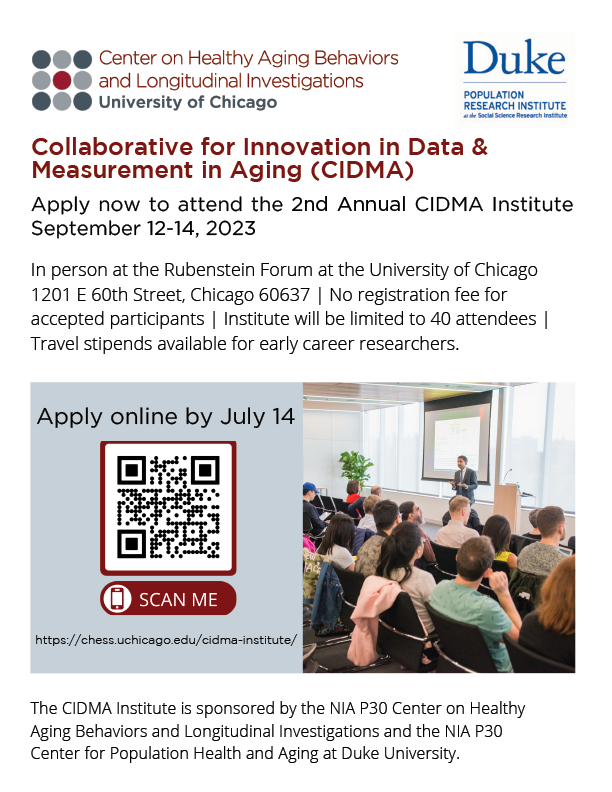
  • In person September 13-14 (opening evening reception on September 12)
  • The Rubenstein Forum at the University of Chicago, 1201 E 60th Street, Chicago 60637
  • No registration fee for accepted participants
  • Limited to 40 attendees
  • Travel stipends available for early career researchers

Researchers at the University of Chicago and Duke invite you to apply for the 2nd annual Collaborative for Innovation in Data & Measurement in Aging (CIDMA) Institute, held at the University of Chicago, September 13-14, 2023 (opening evening reception on September 12). The goal of CIDMA is to identify, design, conduct and assess innovations in data collection and measurement within longitudinal research on aging and disseminate the findings of these assessments broadly.

The 2nd annual CIDMA Institute will bring together researchers and data collection professionals for a two-day interactive workshop focused on identifying ongoing challenges in data collection and measurement and brainstorming potential innovations to address these challenges. In addition, researchers leading the initial CIDMA assessment projects will present preliminary results and lead a discussion on opportunities for future applications. Participants are encouraged to bring challenges from their own research to share with the group. Learn more about the Institute and apply to attend here.

Please contact Absera Melaku at [email protected] with questions. The CIDMA Institute is sponsored by the NIA P30 Center on Healthy Aging Behaviors and Longitudinal Investigations (CHABLIS) and the NIA P30 Center for Population Health and Aging at Duke University (CPHA). The faculty organizers for the institute are Kathleen Cagney, PhD, University of Michigan, Joe Hotz, PhD, Duke University, and David Meltzer, MD, PhD, University of Chicago.

This webinar will be hosted by the Coordinating Center for the Centers on the Demography and Economics of Aging and Alzheimer’s Disease and Related Dementias; the Center for Demography of Health and Aging (CDHA) at the University of Wisconsin- Madison; the Center on Aging & Population Sciences (CAPS) at University of Texas, Austin; and the Life Course Center for the Demography and Economics of Aging (LCC) at the University of Minnesota.

Register for the webinar.

Presenters:
John Robert “Rob” Warren, University of Minnesota with Eric Grodsky, University of Wisconsin-Madison
Chandra Muller, University of Texas at Austin
Adam Brickman and Jennifer Manly, Columbia University

Amanda Sonnega, Coordinating Center Director will moderate

Every decade, the US Department of Education conducts a large cohort study of a nationally representative sample of high school students; those students are followed for about a decade, and comprehensive information about their families, schools, educational experiences, peers, and other life contexts is collected from school transcripts and interviews with students, parents, teachers, and school administrators.

We revived and repurposed two of those cohorts — the 1972 National Longitudinal Study of the High School Class of 1972 (NLS-72) cohort and the 1980 High School and Beyond (HSB) cohort — to become studies of aging and later life well-being. This talk will focus on the design and potential of the 2021 (age-60) HSB follow-up and the 2024 (age-70) NLS72 follow-up. Both feature rich measures of cognitive impairment, health, and socioeconomic outcomes; both include surveys, cognitive assessments, in-home visits, blood and saliva biomarkers, and administrative record linkages. To these, the 2024 NLS72 will add MRIs for a subsample of respondents. Education Studies for Healthy Aging Research (EdSHARe) is the broader project that includes these cohorts.

This webinar will be hosted by the Coordinating Center for the Centers on the Demography and Economics of Aging and Alzheimer’s Disease and Related Dementias; the Center for Demography of Health and Aging (CDHA) at the University of Wisconsin-Madison; the Center on Aging & Population Sciences (CAPS) at University of Texas at Austin; and the Life Course Center for the Demography and Economics of Aging (LCC) at the University of Minnesota.

Background: The Demography and Economics of Aging Centers Program, expanded to include Alzheimer’s Disease and Alzheimer’s Related Dementias, has contributed significantly to developing both innovative lines of research and the next generation of scholars in the field. New areas and new directions have emerged (such as population genetics and biomeasure collection within national population-based surveys), largely because of increasing cross-disciplinary collaborations encouraged by the Centers. This successful model represents multiple centers engaged in a range of research and infrastructure activities within thematic research areas. There is wide recognition within the National Institute on Aging and in the field that the full promise of the center mechanism itself and, indeed, the pace of future scientific discovery in aging will depend on scholars continuing to bridge disciplinary divides.

This webinar is sponsored by the National Institute on Aging (P30AG017266; P30AG066614; P30AG066613; R24AG066588)

CAPS, Life Course Center, Centers on the Demography & Economics of Aging and Alzheimer's Disease and Alzheimer's Related Dementias, Center for the Demography of Health & Aging (CDHA)

Gateway to Global Aging Data8am US Pacific Time, 11am US Eastern Time, and 5pm Central European Time
Joan Costa-Font, London School of Economics, will be presenting “Are Long Term Care Subsidies and Supports Productive? Effects on Health and Wellbeing”.

Please join the seminar using the following Zoom link: https://usc.zoom.us/j/92657349655

Abstract
We examine whether the extension of LTC subsidies and supports produce any health and wellbeing returns. We show that SAAD, a reform that universalized subsidies and in Spain impacted survival, mental health, subjective longevity and life expectancy. Furthermore, we document that indeed the effect differs by the effectiveness at the implementation of SAAD. Finally, we provide an estimate of the cost-effectiveness of SAAD.

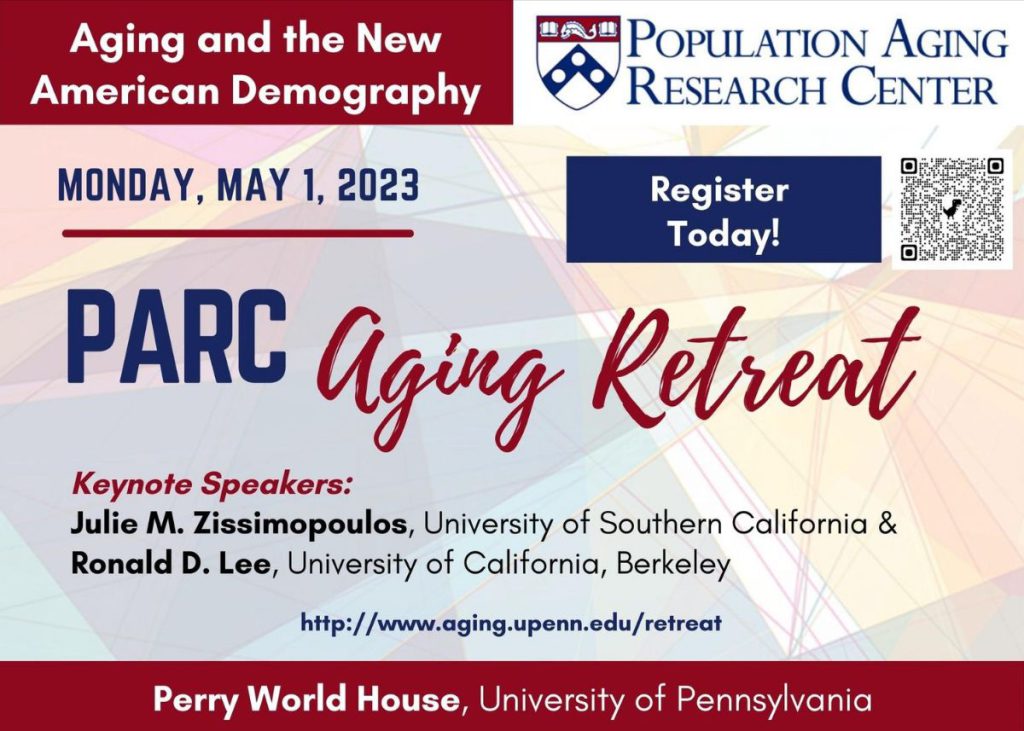
PARC Aging Retreat Monday, May 1, 2023You are cordially invited to join us on May 1st for the 2023 PARC Aging Retreat, a hybrid event, which will bring together PARC Research Associates and aging researchers from across Penn as well as externally. Please register to attend and join us on Zoom. For more information or to view the preliminary schedule, please visit the 2023 PARC Aging Retreat webpage.
Keynote Speakers:
Julie M. Zissimopoulos, University of Southern California
Ronald D. Lee, University of California, Berkeley

Zoom Join Link | Meeting ID: 938 3803 2603 | Passcode: 506263
Add to: Google Calendar | Outlook Calendar

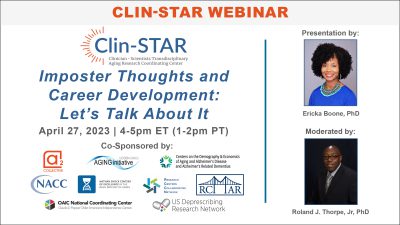
Clin-STAR Webinar Imposter Thoughts and Career Development: Let’s Talk About It Thursday, April 27, 2023, 4-5 pm ETCo-sponsored by Centers on the Demography and Economics of Aging Coordinating Center

The learning objectives of this webinar are to:

  • Develop additional understanding of how imposter thoughts can impact career development and growth opportunities
  • Discuss personal coping strategies that can be utilized to recognize and negate imposter thoughts
  • Discuss how institutional culture can perpetuate feelings of professional imposterism and how institutional leadership can take greater responsibility in growing and sustaining more supportive environments

Register here

Presentation by Ericka Boone, Director, Division of Biomedical Research Workforce, Office of Extramural Research, NIH. Moderated by Roland J. Thorpe, Associate Vice Provost of Faculty Diversity, Johns Hopkins University.